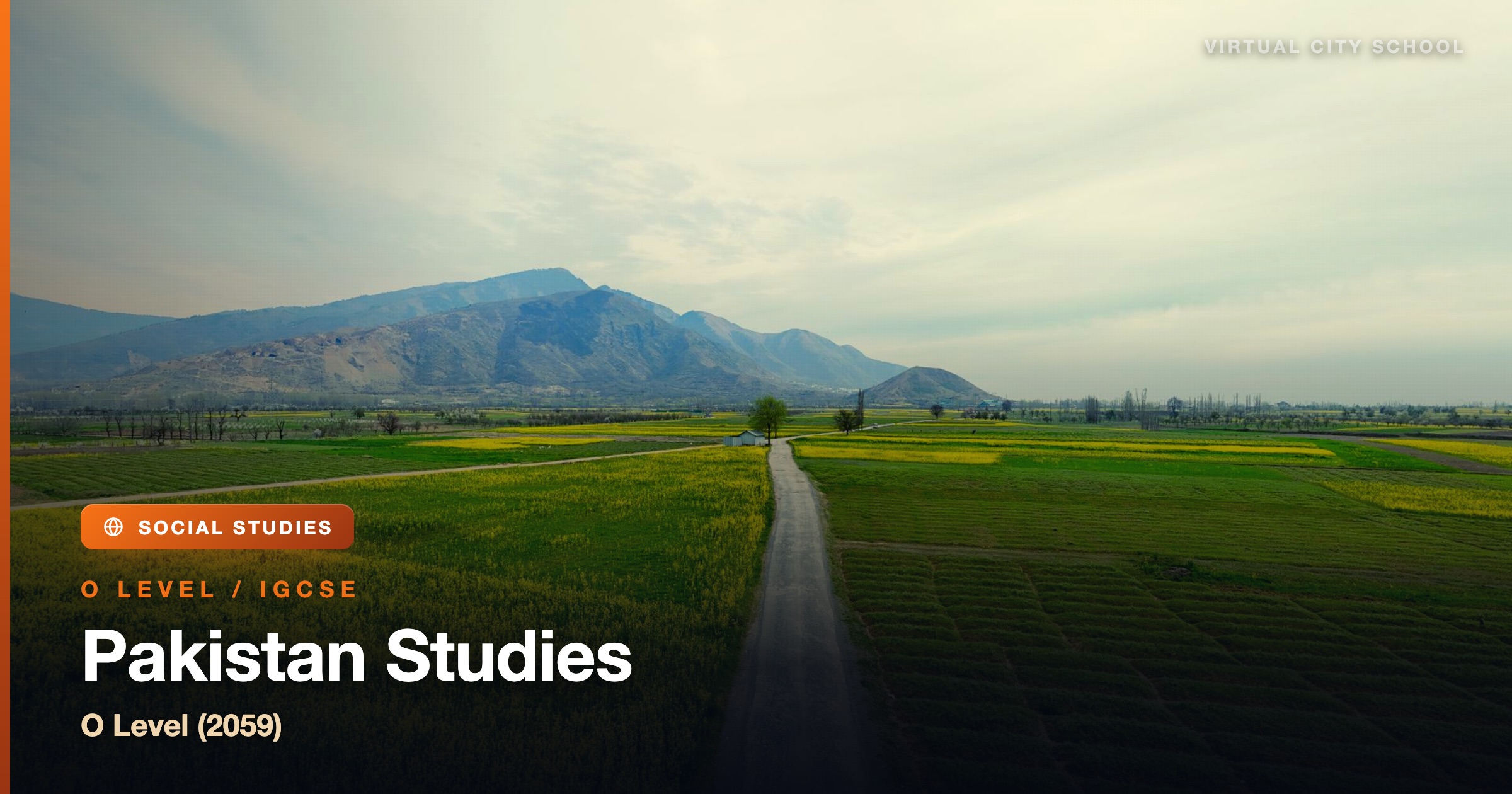
Pakistan Studies — O Level (2059)
About this course
This course prepares students for the Cambridge O Level Pakistan Studies examination (Syllabus 2059). Students will develop a deep understanding and appreciation of the culture, history and political development of Pakistan (Paper 1: The History and Culture of Pakistan), alongside the country's physical and human environment and its economic and social development (Paper 2: The Environment of Pakistan). The course builds skills of handling information, analysis, evaluation and communication. Ideal for students in Grades 9–10 seeking a rigorous, internationally recognised qualification in the history, culture and geography of Pakistan.
Course Outline
• Introduction to Cambridge O Level Pakistan Studies (Syllabus 2059)
• Examination Structure — Paper 1 (History and Culture of Pakistan) and Paper 2 (Environment of Pakistan)
Paper 1: The History and Culture of Pakistan
• Cultural and Historical Background to the Pakistan Movement — religious reform movements, Shah Waliullah, Syed Ahmad Barelvi and the Jihad movement, Haji Shariatullah and the Faraizi Movement
• The Decline of the Mughal Empire — internal and external reasons for Mughal decline, the rise of British influence in the subcontinent
• The War of Independence 1857–58 — causes, events and consequences
• Sir Syed Ahmad Khan and the Aligarh Movement — his educational and political work, the Two-Nation Theory, the Hindu–Urdu Controversy
• Urdu and Regional Languages — the importance of Urdu and the promotion of regional languages since 1947
• The Emergence of Pakistan 1906–47 — the Simon Commission, the Nehru Report, Jinnah's 14 Points, the Round Table Conferences, the Government of India Act 1935, the Pakistan Resolution 1940, the Cabinet Mission Plan, and Partition in 1947
• Nationhood 1947–99 — the constitutional and political history of Pakistan, and Pakistan's international relations and role in world affairs, including its nuclear programme
Paper 2: The Environment of Pakistan
• The Land of Pakistan — location, natural topography and drainage, climate
• Natural Resources and Sustainability — water, forests, mineral resources and fisheries
• Agricultural Development — agricultural systems, crops and livestock, factors affecting production
• Industrial Development — key industries and their location and development
• Trade — major exports and imports, Pakistan's trading partners
• Population and Employment — population structure and growth, movements of population, distribution and density, employment
• Past Paper Practice — Paper 1 and Paper 2 timed exercises and model answers
One-time payment