Beyond the Classroom: How Virtual Learning Connects Students to the World
Education is no longer limited by the four walls of a classroom. In a traditional school, students often spend most of their academic years learning alongside children from the same city, community and cultural background.
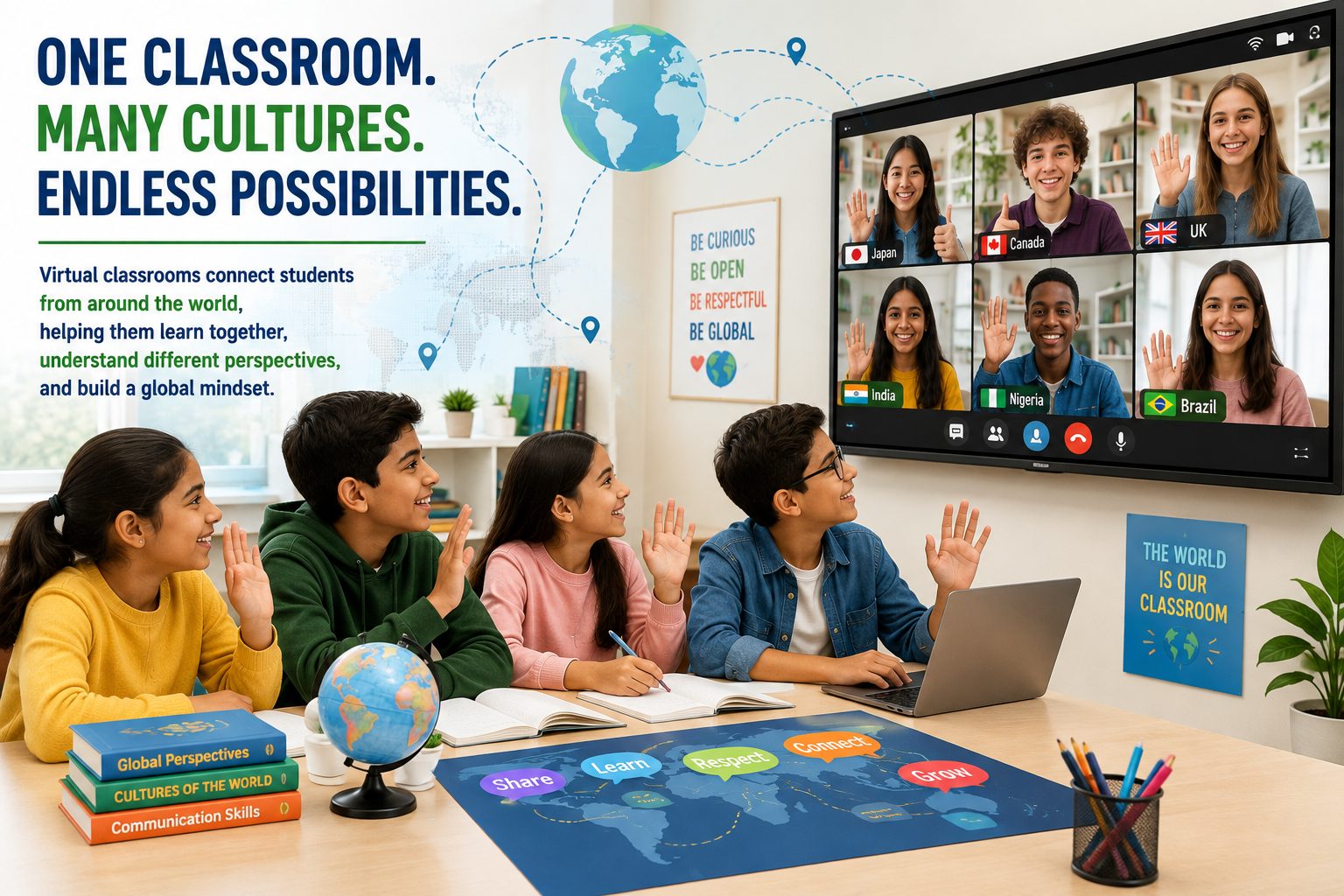
Education is no longer limited by the four walls of a classroom.
In a traditional school, students often spend most of their academic years learning alongside children from the same city, community and cultural background. They may have limited opportunities to interact with people whose languages, traditions, perspectives and experiences are different from their own.
Virtual classrooms are changing this.
When students from different countries come together in an online classroom, they are not simply learning a subject. They are learning about the world.
🌍 One Classroom, Many Cultures
Imagine a virtual English class where a student from Pakistan is discussing a story with students from the UK, UAE, Malaysia, Canada or another part of the world.
They may all be studying the same text, but their interpretations may be completely different.
Why?
Because our understanding of the world is influenced by our culture, experiences and surroundings.
A student may say, “This character's decision was completely wrong.”
Another student may respond, “I don't think so. In my culture, that decision would be understood differently.”
Suddenly, a literature lesson becomes something much bigger.
Students are learning to listen, question, compare and reconsider their own assumptions.
💡 Learning That Goes Beyond Textbooks
Textbooks can tell students about different countries.
But interacting with people from those countries allows students to experience different perspectives directly.
A student may learn about Japanese traditions in a textbook, but speaking to a Japanese classmate can make that knowledge more meaningful.
A student studying global issues can hear how climate change, education, technology or social challenges are perceived by young people living in different parts of the world.
This creates a form of learning that cannot always be achieved through memorisation.
The world itself becomes part of the classroom.
🗣️ Communication Skills Become More Authentic
There is another important advantage: communication.
Students often learn English through textbooks and examinations. But communicating with people from different linguistic and cultural backgrounds requires something more.
They need to explain their ideas clearly.
They need to listen carefully.
They need to ask questions.
They need to understand different accents and expressions.
Most importantly, they learn that effective communication is not simply about speaking correct English. It is about making yourself understood and understanding others.
A virtual classroom can therefore provide students with authentic opportunities to practise communication skills.
🌏 Breaking Cultural Stereotypes
We often form opinions about other countries through films, social media, news and stereotypes.
Direct interaction can challenge those assumptions.
A student may discover that a classmate from another country has the same favourite sport, enjoys the same music or worries about the same examinations.
At the same time, they may discover traditions and viewpoints that are completely unfamiliar.
This teaches an important lesson:
People can be different from us without being strangers to us.
Students begin to see diversity as something to understand rather than something to fear.
🧠 Developing a Global Mindset
The workplace of the future is increasingly global.
Students may eventually work with colleagues from different countries, communicate with international clients, attend universities abroad or participate in multinational projects.
Why wait until adulthood to develop these skills?
Virtual classrooms can introduce students to international interaction while they are still learning.
They begin developing:
- Cultural awareness
- Open-mindedness
- Respect for different perspectives
- Communication skills
- Collaboration
- Confidence
- Adaptability
- Global awareness
- Critical thinking
These are not merely academic skills.
They are life skills.
🤝 Learning to Disagree Respectfully
One of the most valuable lessons a diverse classroom can teach is that disagreement does not have to become conflict.
Students may have different opinions about politics, literature, social issues, traditions or everyday life.
A well-managed virtual classroom can teach them how to say:
“I understand your perspective, but I see it differently.”
That is an incredibly important skill in today's interconnected world.
Students learn that listening does not mean agreeing—and respecting another person's perspective does not require abandoning their own.
🌐 Virtual Learning Makes the World Smaller
Perhaps this is one of the greatest strengths of virtual education.
A student sitting at home can enter a classroom where the world is represented through the people around them.
Geographical distance becomes less significant.
A child does not need to travel thousands of kilometres to meet someone from another culture.
They can simply log into a classroom.
Of course, technology alone does not create meaningful interaction. Teachers must deliberately design collaborative activities, discussions and projects that encourage students to engage with one another.
The quality of the teaching still matters.
But when thoughtfully designed, the virtual classroom can become a powerful space for international learning.
🎓 Preparing Students for a Global Future
Education should prepare students not only for examinations but also for the world they will enter.
That world is increasingly interconnected.
Universities are international.
Businesses operate across borders.
Research is collaborative.
Communication happens instantly between countries.
And many careers require people to work with individuals they may never meet face-to-face.
Students who have already experienced diverse perspectives may enter that world with greater confidence and adaptability.
The classroom is no longer just a place where students learn about the world.
It can be a place where students meet the world.
A virtual classroom can give a student something that no textbook can fully provide:
the opportunity to see the world through another person's eyes.
And perhaps that is one of the most valuable forms of education we can offer the next generation.
Because a truly educated person does not simply know more about the world—they understand that the world can look very different from another person's perspective.
🌍 One classroom. Different cultures. Shared learning. A broader horizon.