How AI Is Transforming Education: Can the Conventional System Keep Up?
Artificial Intelligence is no longer a futuristic concept waiting to enter our classrooms. It is already here. Students are using AI to explain difficult concepts, generate ideas, practise languages, receive instant feedback and explore subjects beyond their textbooks.
The question is no longer “Will AI change education?”
It already has.
The more important question is:
Can our conventional education system keep up?
Education Is Changing Faster Than the Classroom
For generations, the traditional model of education has remained remarkably similar: a teacher stands in front of a class, explains a topic, students take notes, homework is assigned, examinations are conducted, and grades are awarded.
This model served an important purpose.
But today's students have access to something previous generations never had: instant, personalised access to information and learning support.
A student struggling with algebra can ask AI to explain the concept in simpler language.
A student learning English can practise conversations without feeling embarrassed about making mistakes.
A student preparing for an examination can receive additional questions at different levels of difficulty.
A teacher can create multiple versions of an activity for students with different learning needs.
The classroom is no longer the only place where learning happens.
From One-Size-Fits-All to Personalised Learning
Perhaps the biggest transformation AI can bring to education is personalisation.
In a conventional classroom, one teacher may be responsible for dozens of students. The lesson is generally delivered at one pace, even though students have different abilities, learning styles and difficulties.
Some students understand immediately.
Others need another explanation.
Some are ready for a challenge but become bored because the class has to move at the same pace.
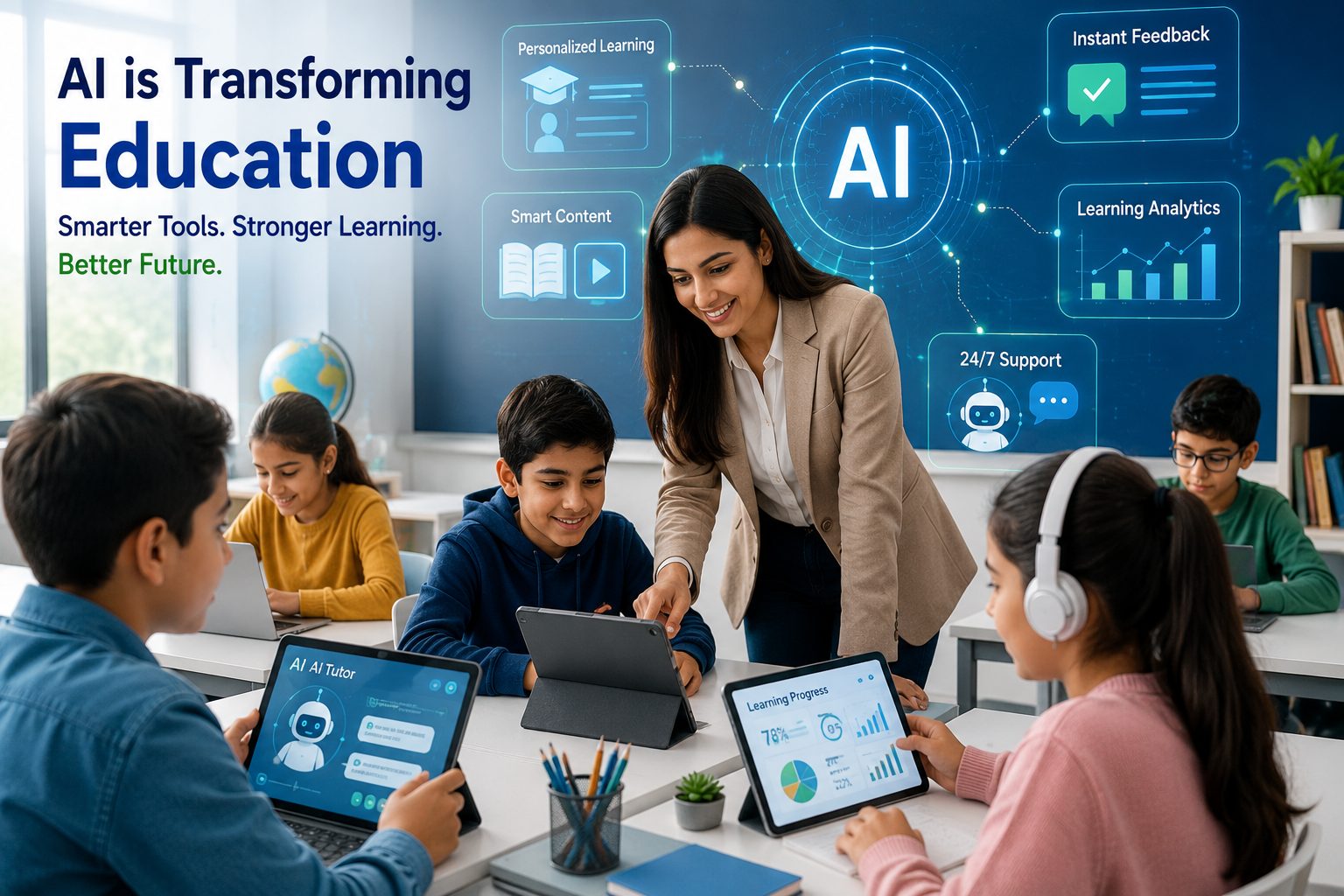
AI can help bridge this gap by providing additional explanations, examples, practice questions and feedback according to individual needs.
This does not mean replacing the teacher.
It means giving the teacher better tools to support individual learners.
Instant Feedback Could Change Everything
Think about the traditional examination cycle.
A student completes an assignment.
The teacher collects it.
The work is marked.
It is returned days—or sometimes weeks—later.
By then, the student may have moved on to another topic.
AI can provide immediate feedback in many learning contexts. Students can identify errors while the learning process is still taking place.
And this matters because feedback is most useful when it comes at the right time.
The future of education may therefore move away from simply asking:
“What marks did the student get?”
and towards:
“What does the student understand, where are the gaps, and what should happen next?”
Teachers Are Not Becoming Less Important
There is a common fear that AI will replace teachers.
The more realistic possibility is different.
AI may replace some tasks traditionally performed by teachers, but it cannot easily replace the human relationship at the heart of education.
A good teacher does much more than deliver information.
A teacher motivates.
A teacher notices when a student has lost confidence.
A teacher understands the difference between laziness and genuine difficulty.
A teacher encourages a struggling child, challenges a capable one and creates a classroom culture where students feel safe enough to make mistakes.
AI can provide information.
Teachers provide human connection, judgement, mentorship and inspiration.
The teacher of the future may therefore spend less time on repetitive administrative work and more time on the things that genuinely require human expertise.
But There Is a Serious Challenge
AI is transforming education—but our conventional system was largely designed for a different era.
A system based heavily on memorisation, standardised examinations and reproduction of textbook knowledge faces a difficult question:
What exactly should students learn when information is available instantly?
If a student can ask AI to write an essay, solve a mathematical problem or summarise a chapter, simply testing whether a student can reproduce information becomes less meaningful.
Education must increasingly focus on:
- Critical thinking
- Problem-solving
- Creativity
- Communication
- Research skills
- Digital literacy
- Ethical decision-making
- Collaboration
- Independent thinking
- The ability to evaluate whether information is actually correct
In other words, we may need to stop teaching students merely how to find answers and start teaching them how to judge answers.
The New Skill: Knowing When Not to Trust AI
AI is powerful—but it is not infallible.
It can make mistakes, provide misleading information, reflect biases and produce confident answers that sound convincing but are incorrect.
Therefore, the AI-ready student cannot simply be someone who knows how to use ChatGPT or another AI tool.
The AI-ready student must know how to question, verify, compare and think independently.
This creates an important new responsibility for schools.
Students need AI literacy just as previous generations needed computer literacy.
They need to understand responsible use, academic honesty, privacy, bias, verification and the difference between using AI as a learning assistant and allowing AI to do the learning for them.
Will AI Make Education More Equal?
This is another important question.
AI has the potential to make high-quality educational support more accessible. A student who cannot afford extensive private tutoring may have access to explanations, practice and learning resources that were previously difficult to obtain.
But technology alone cannot guarantee equality.
Students still need reliable internet, devices, supportive adults, qualified teachers and a safe learning environment.
The challenge is therefore not simply to introduce AI into education.
It is to make sure that AI improves education rather than creating another digital divide.
So, Can the Conventional System Cope?
Yes—but only if it is willing to evolve.
The answer is not to throw away everything traditional.
Teachers will remain important. Structured curricula will remain important. Assessment will remain important. Discipline, social interaction and human relationships will remain important.
But the way we teach, assess and support students must change.
Schools that continue to rely exclusively on memorisation, rigid pacing and end-of-term assessment may find it increasingly difficult to meet the needs of modern learners.
The schools that adapt will be different.
They will combine:
Human teachers + technology + personalised learning + continuous feedback + critical thinking.
That combination could create something far more powerful than either traditional education or AI alone.
The Future Classroom Is Not Teacher vs AI
It is Teacher + AI.
AI can help explain.
The teacher can help the student understand.
AI can generate practice.
The teacher can identify the deeper problem.
AI can provide instant feedback.
The teacher can provide encouragement.
AI can make learning resources more accessible.
The teacher can give learning meaning.
The real question is therefore not:
“Will AI replace schools?”
The better question is:
“Will schools learn to use AI to become better at educating children?”
Education has always evolved with technology—from the blackboard to the textbook, from the computer to the internet.
AI is simply the next major transformation.
The schools that recognise this change early will not necessarily be the ones with the most technology.
They will be the ones that understand something much more important:
Technology should not replace good education. It should make good education more personalised, accessible, responsive and human.
The future belongs not to students who can memorise the most information, but to those who can think, question, create, adapt and learn continuously.
And that is exactly where education must go next.